

Initial Assessment £130
Not sure what's going on? This is where we start.
Living with dizziness, vertigo, or balance problems can be unsettling — especially when you don't know what's causing them. Our initial assessment is designed to give you space to talk through your symptoms, begin making sense of what's happening, and take the first steps toward feeling better.
You don't need a GP referral. You can book directly with us.
What is the initial assessment?
The initial assessment is a comprehensive 60-minute appointment that combines a detailed conversation about your symptoms with a series of simple, non-invasive tests. It's designed to give us a first glance of your balance and vestibular health, identify the most likely cause of your symptoms, and point us in the right direction for next steps.
It's the ideal starting point whether your symptoms have just started or have been going on for some time — and whether you have a rough idea of what might be wrong, or no idea at all.

What does it involve?
Case History
We begin by taking time to really listen. We'll ask you about your symptoms in detail — when they started, what they feel like, what makes them better or worse, and how they're affecting your day-to-day life. We'll also ask about your general health, any medications you take, and your personal and family medical history.
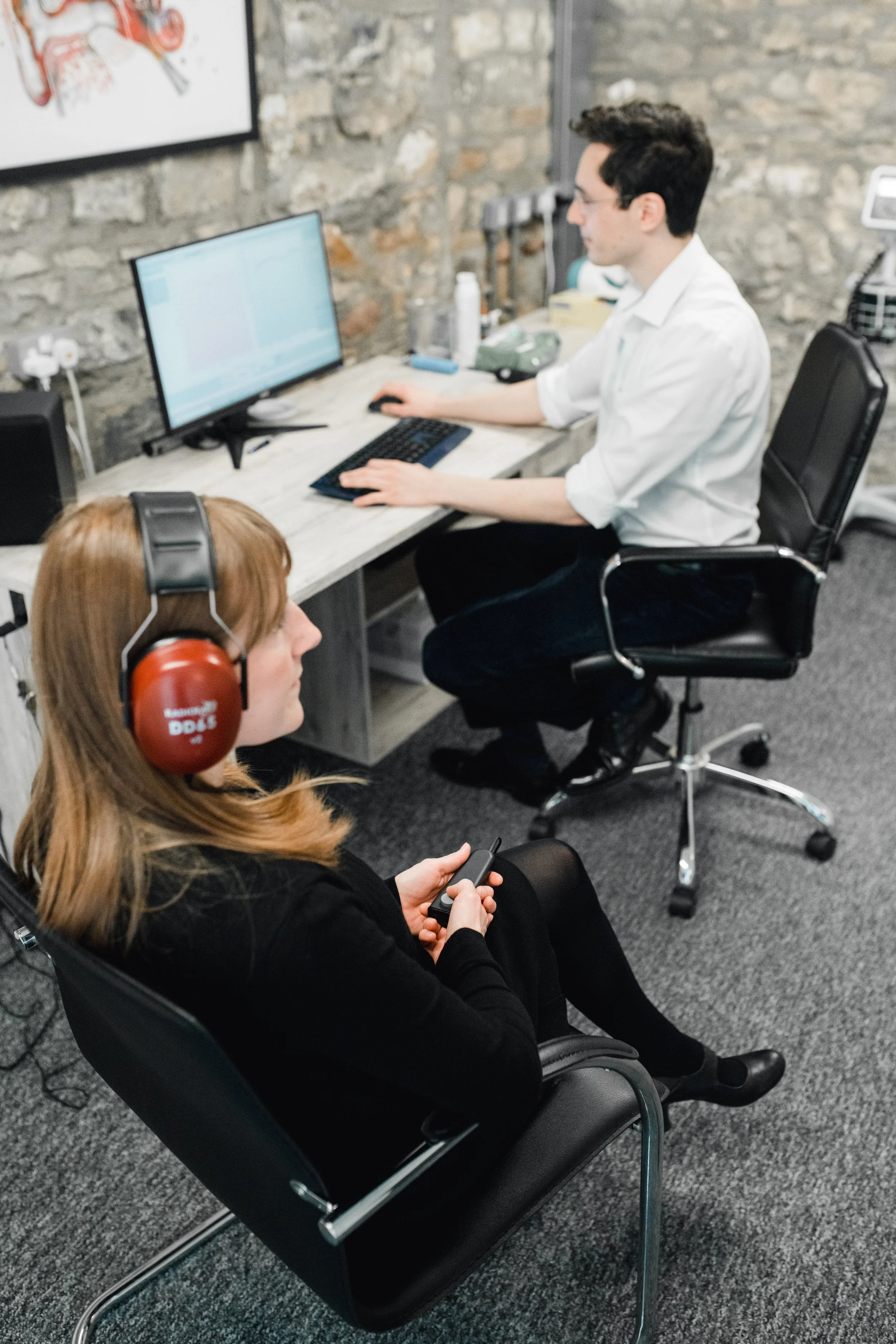
Hearing Assessment
Because your hearing and balance systems share the same inner ear, a hearing assessment is a valuable part of any vestibular evaluation. We'll assess how well you're hearing across a range of frequencies, which can help us identify conditions that affect both hearing and balance.
Positioning Tests
We'll carry out a series of positioning tests to assess whether BPPV (Benign Paroxysmal Positional Vertigo) may be responsible for your symptoms. If BPPV is identified, we can discuss treatment options with you straight away.
Romberg Test
The Romberg test is a simple but informative assessment of your static balance — how well you can maintain your balance while standing still.
Unterberger Test
The Unterberger test — sometimes called the Fukuda stepping test — assesses whether there is an asymmetry in your vestibular system. You'll be asked to march on the spot with your arms outstretched and your eyes closed.
Tandem Gait
Tandem gait assesses your dynamic balance — your ability to maintain stability while moving. You'll be asked to walk in a straight line, placing one foot directly in front of the other as if walking along a tightrope.
CTSIB — Clinical Test of Sensory Interaction on Balance
The CTSIB is similar to the Romberg, but instead we’ll ask you to stand on a soft foam pad, sometimes with your eyes shut. It helps us identify where a weakness may be that’s contributing to you unsteadiness.
What happens at the end of the appointment?
Once all the tests are complete, we'll sit down and go through everything with you clearly and in plain language. We'll explain what each test showed, share our thoughts on the most likely cause of your symptoms, and give you our honest recommendation on what we think the best next steps are.
This might mean a follow-up appointment for more advanced testing, a course of vestibular rehabilitation, a referral to another specialist, or simply reassurance that nothing serious has been found. Whatever the outcome, you'll leave with a clear picture of where things stand — and a defined path forward.

Ready to take the next step?
If you’d like help to get your balance problems resolved, get in touch and we’ll guide you through the process, from arranging an appointment to a friendly introductory phone call with one of our specialists.