
Computerised Posturography
How your brain uses information from your vision, inner ears and muscles
Maintaining your balance is far more complex than simply having healthy inner ears. Every second, your brain combines information from your eyes, your balance organs and the muscles and joints throughout your body to keep you upright.
Computerised Posturography is an advanced balance assessment that objectively measures how well these systems work together. It provides valuable information about your balance that cannot be obtained simply by watching you stand or walk.
What Is Computerised Posturography?
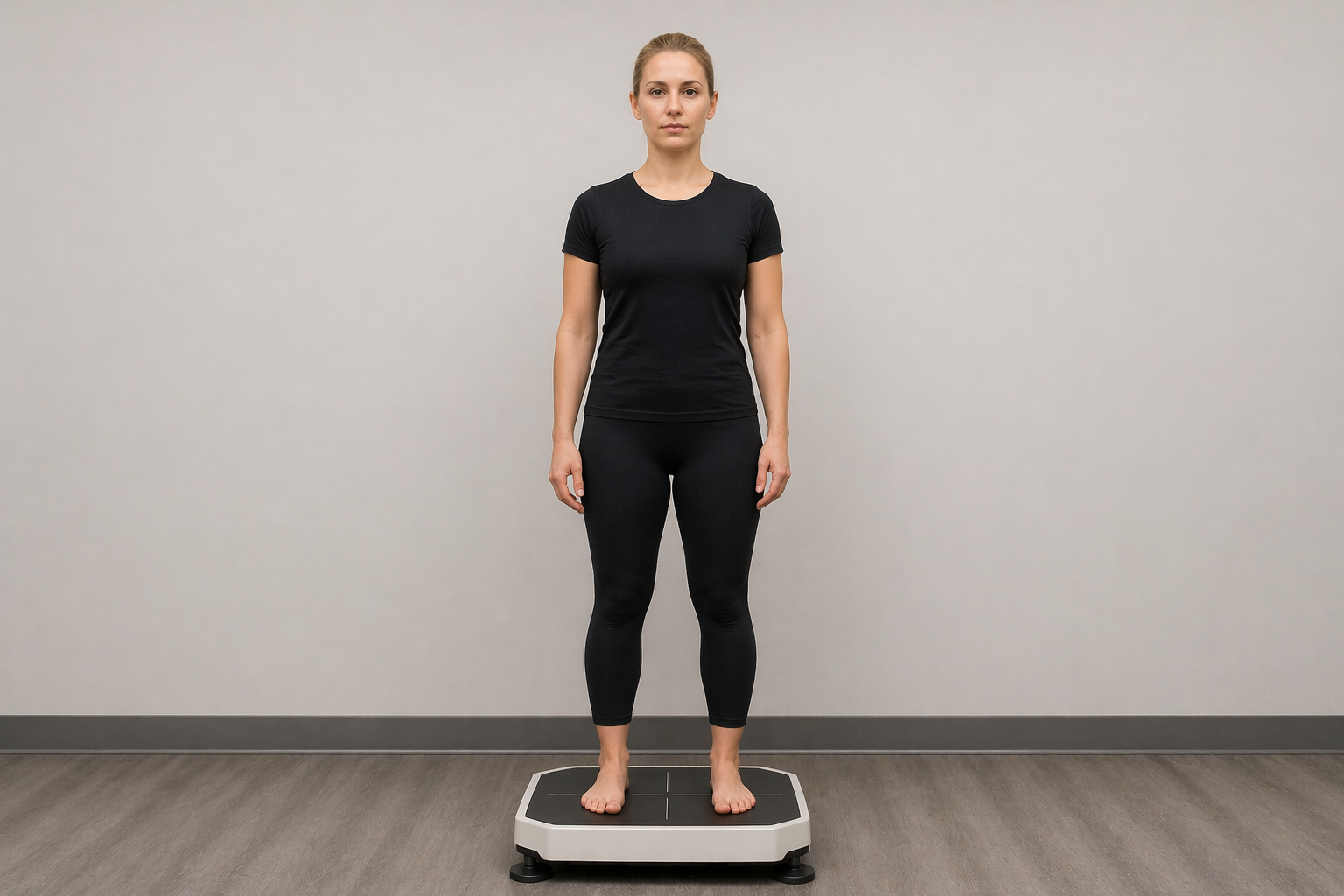
Computerised Posturography is a specialised test that measures your ability to maintain balance under a series of carefully controlled conditions.
At Northern Balance Clinic, we use a highly sensitive Bertec force platform, which records tiny movements of your body's centre of pressure while you are standing.
By altering the sensory information available to your brain, we can assess how effectively you use your vision, vestibular system and proprioception (sensory information from your muscles and joints) to remain balanced.
Why Might I Need Computerised Posturography?
Your clinician may recommend this assessment if you experience:
Persistent dizziness
Feeling off balance
Frequent falls
Difficulty walking in darkness
Unsteadiness on uneven ground
Balance problems following concussion
Age-related balance problems
Suspected vestibular disorders
The assessment also provides an excellent way of objectively measuring improvements during vestibular rehabilitation.
How Do We Maintain Balance?
Maintaining balance depends on three sensory systems working together:
Vision - Your eyes provide information about your surroundings and your body's position within them.
The Vestibular System - The balance organs in your inner ears detect movement and head position.
Proprioception - Sensors within your feet, muscles and joints constantly inform your brain about the position of your body.
Your brain combines information from all three systems every second. If one system becomes less reliable, your brain should be able to compensate by relying more heavily on the remaining systems. Computerised Posturography helps determine how well this process is working.
What Happens During the Test?
The assessment consists of standing on the Bertec platform under several different conditions, including:
Eyes open on a firm surface
Eyes closed on a firm surface
Eyes open while standing on a foam surface
Eyes closed while standing on a foam surface
These conditions form part of the Modified Clinical Test of Sensory Interaction on Balance (mCTSIB).
Throughout the assessment, the force platform measures tiny movements of your body that are far too small to detect by observation alone.
The assessment usually takes around 10 minutes.
What Does Computerised Posturography Measure?
The assessment provides objective measurements of:
Overall postural stability
Amount of body sway
Balance strategy
Dependence on vision
Dependence on proprioception
Dependence on the vestibular system
Risk of falls
These measurements help identify subtle balance problems and provide an objective baseline for future comparison.
What Conditions Can Computerised Posturography Help Assess?
Computerised Posturography provides valuable information when investigating:
Bilateral Vestibular Loss - Patients often demonstrate increased body sway, particularly when vision is removed.
Vestibular Neuritis - The assessment helps evaluate recovery and central compensation following vestibular injury.
Persistent Postural-Perceptual Dizziness (PPPD) - Some patients develop altered balance strategies and increased visual dependence.
Age-Related Balance Problems (Presbyvestibulopathy) - The assessment helps identify age-related changes affecting postural stability and fall risk.
Concussion and Head Injury - Persistent balance abnormalities following concussion may be detected, even when routine examination appears normal.
Neurological Disorders - Computerised Posturography can demonstrate abnormal balance performance and help determine whether further neurological investigation is appropriate.
Does the Test Make You Dizzy?
Most people tolerate the assessment very well. Standing on the foam surface with your eyes closed may feel slightly more challenging, particularly if you have a vestibular disorder, but the test itself does not usually provoke significant dizziness.
Why Is Computerised Posturography Useful?
Unlike many vestibular tests that assess individual parts of the balance system, Computerised Posturography measures how your body functions as a whole.
It helps us to:
Objectively quantify balance performance
Assess how different sensory systems contribute to balance
Identify subtle balance impairments
Monitor recovery following treatment
Guide vestibular rehabilitation programmes
Evaluate fall risk
Is Computerised Posturography Performed Alongside Other Vestibular Tests?
Yes. Computerised Posturography is often combined with:
Caloric testing
Positional testing for BPPV
Together, these investigations provide a comprehensive assessment of your vestibular system and overall balance.
How Can Northern Balance Clinic Help?
At Northern Balance Clinic, Computerised Posturography forms an important part of our comprehensive vestibular assessment.
Using our Bertec force platform alongside advanced vestibular investigations, we can objectively assess how your balance system is functioning and identify the underlying cause of your symptoms.
This assessment can help diagnose and monitor conditions including:
Bilateral vestibular loss
Vestibular neuritis
Vestibular migraine
Persistent Postural-Perceptual Dizziness (PPPD)
Age-related balance disorders
Dizziness following concussion
Functional balance disorders
The results also help us develop personalised rehabilitation programmes and monitor your progress throughout treatment.
Book a Comprehensive Vestibular Assessment
If you are experiencing dizziness, imbalance or falls, our specialist vestibular clinicians can perform Computerised Posturography as part of a comprehensive balance assessment to help identify the cause of your symptoms.
Ready to take the next step?
If you’d like help to get your balance problems resolved, get in touch and we’ll guide you through the process, from arranging an appointment to a friendly introductory phone call with one of our specialists.